This site is intended for Indian residents.
When non-surgical and arthroscopic treatments do not bring enough relief and is impacting your everyday life, your doctor may advise a shoulder replacement, also called shoulder arthroplasty.
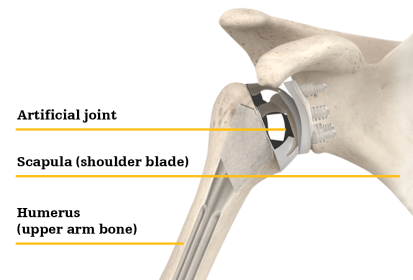
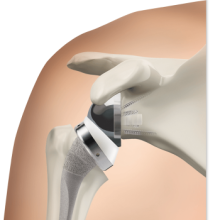
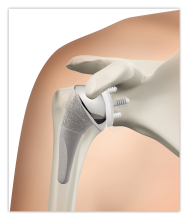
During a shoulder replacement surgery, your surgeon will replace the damaged end of the upper arm bone and shoulder socket (glenoid) with artificial implants. This allows your shoulder joint to move smoothly and relieves pain.
You have options even with shoulder replacement. Based on your joint condition, your surgeon may suggest a reverse shoulder replacement or total shoulder replacement to get you moving again. Today, with technological advancements surgeons have different tools to assist them in planning shoulder replacement based on each patient’s unique joint anatomy and condition. Like any surgery, joint replacement has risks. Speak to your doctor to determine if it is right for you.

Reverse shoulder replacement
3D pre-operative planning
Benefits of 3D visualization
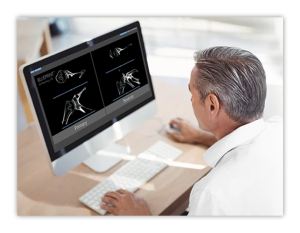
Before surgery, a CT scan of your shoulder is taken. This enables your surgeon to visualize your unique shoulder anatomy.
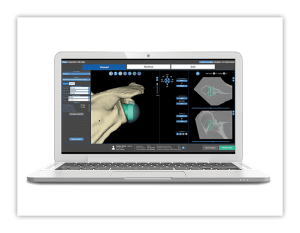
Next, the CT scan images are loaded into the pre-operative planning software to develop a 3D model of your shoulder for your surgeon to virtually perform your shoulder replacement surgery.
Based on your bone structure and joint damage, your surgeon will finalize a customized surgical plan, including implant size and placement, and may order a PSI to replicate the plan during surgery.
During surgery, your surgeon will follow your customized surgical plan for your shoulder replacement.
Total shoulder replacement
In a primary total shoulder replacement, the original anatomy of the shoulder joint is maintained. This approach may be recommended for severe shoulder arthritis patients, whose rotator cuff is healthy and intact. Your surgeon will remove the diseased end of the upper arm bone (humeral head) and replace it with a spherical shaped implant that fits into a stem placed inside the bone. Then, the shoulder’s socket (glenoid) is prepared, and a plastic (polyethylene) cup is attached on it with bone cement.
Speak with your doctor to know the right treatment for your shoulder condition.
The information provided on this website is for general informational purposes only and is not intended as a substitute for professional medical advice, diagnosis, or treatment. Always seek the guidance of a qualified healthcare professional with any questions you may have regarding a medical condition or treatment options. Stryker does not dispense medical advice. This website may include contact details of hospitals, shared solely to help patients identify and contact healthcare facilities. Inclusion in this contact list does not imply endorsement, affiliation, or recommendation by Stryker India Pvt. Ltd. (“Stryker”). The information displayed is published with the consent of the respective institutions and is believed to be accurate at the time of posting. Stryker shall not be liable for any direct, indirect, incidental, or consequential damages arising out of or in connection with the use or misuse of the content on this website or the services of any listed providers. This website may contain links to external websites not operated or controlled by Stryker. We are not responsible for the content, accuracy, or privacy practices of such external sites. All content on this website, including text, graphics, logos, and other materials, is the property of Stryker or its licensors and is protected under applicable intellectual property laws. Unauthorized use is strictly prohibited. Stryker reserves the right to modify or update this disclaimer at any time without prior notice. Continued use of the website constitutes acceptance of any changes made.